
New vehicle sales in the ASEAN region’s six main markets declined by close to 15% to 804,522 units in the first quarter of 2014, from 941,754 units a year earlier, according to data compiled exclusively for just-auto by Tony Pugliese.
Regional sales once again were dragged lower by a sharp decline in the Thai market, as the country’s political crisis continued to negatively impact consumer and business sentiment. Private investment has shrunk and consumer spending has weakened significantly in recent months.
Go deeper with GlobalData


Discover B2B Marketing That Performs
Combine business intelligence and editorial excellence to reach engaged professionals across 36 leading media platforms.
The Thai vehicle market is also in the process of normalising following the withdrawal of the government’s first-time buyer incentive programme at the end of 2012.
All other markets in the region performed positively in the first quarter, with strong domestic consumption continuing to drive economic growth. New record highs were reported in Indonesia, Malaysia and the Philippines.
New vehicle sales in Indonesia increased by close to 11% to 328,354 units, making it the largest market in the ASEAN region ahead of Thailand. Here, the introduction of low-cost green cars (LCGCs) by the dominant Japanese manufacturers in the fourth quarter of 2013 has helped underpin the overall market, offsetting higher Bank Indonesia benchmark interest rates and the instruction of tougher lending rules last year.
First-quarter new vehicle sales in the Philippines increased by over 21% to 59,556 units, with the domestic economic continuing to benefit from record-low interest rates and fast growth in the service sector. New models are also helping to drive buying activity in the market.
Malaysia too continued to enjoy strong domestic economic growth, although the vehicle market is beginning to look saturated in the short term at current levels. Record-high household debt could hold back domestic consumption growth this year, although the government hopes this will be offset by stronger export growth.
The Vietnamese economy continued to recover from a prolonged period of double-digit inflation, with lower interest rates now helping to drive the recovery in the domestic vehicle market. Sales here increased by over 29% year-on-year to 24,168 units – the fastest rate of growth in the region in this period.
New vehicle registrations in Singapore have also begun to recover after years of decline, with high vehicle ownership taxes and low import quotas set by the government affecting volumes. Sales here increased by close to 21% to 8,363 units in the first quarter.
Thailand
First-quarter new vehicle sales in Thailand fell by 45.7% to 224,171 units, from 412,680 units a year earlier, according to the Federation of Thai Industries, with sales in March also sharply lower – by 46.5% at 83,893 units.
While political tensions on the streets of the capital city Bangkok have eased in recent months, the political stalemate between the ruling and opposition parties shows no sign of being resolved. The resulting uncertainty continues to hurt sentiment and consequently vehicle purchasing activity.
The vehicle market also is still in the process of “normalising” in the aftermath of the government’s first-time buyer incentive programme, which expired at the end of 2012.
Economic growth is estimated to have fallen sharply in the first quarter, with consumer and business sentiment continuing to deteriorate. Private investment is estimated to have shrunk significantly in the first quarter, with activity delayed or cancelled as the political crisis continues to hold back government budgeting and planning.
Consumer spending also weakened significantly in the first quarter, prompting Bank of Thailand to cut its benchmark interest rate by 25 basis points to 2.0% in March. It is now the lowest rate in the ASEAN region.
Bank of Thailand and other economic institutions expect full-year economic growth to fall to around 2.7% in 2014 and possibly lower if a solution to the political crisis is not found soon. New vehicle sales are expected to decline by at least 10%, with year-on-year comparisons starting to improve in the second half of the year.
Indonesia
Indonesia’s new vehicle market expanded by close to 11% to 328,354 units in the first quarter of 2014, from 295,992 units in the same period of last year, reflecting continued strong domestic economic growth and buoyant consumer and business sentiment.
Economic growth is estimated to have remained stable at 5.8% year-on-year in the first quarter, helped by general election spending and a moderate recovery in exports. Capital inflows increased slightly to USD 5.8 billion in the first quarter, however, and the lack of a clear winner in the April 9 general election is creating lingering uncertainty for investors.
The first-quarter’s vehicle market growth followed of a series benchmark interest rate hikes by the Bank of Indonesia last year, totalling of 150 basis points to 7.25%, and the introduction stricter lending rules. Inevitably, these measures have put additional pressure on household budgets.
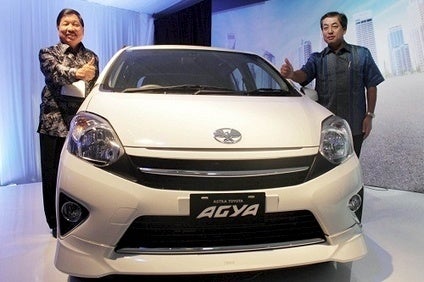
The launch late last year of several cheap small cars under the government’s low-cost green car (LCGC) programme, such as the Toyota Agya and Daihatsu Ayla, helped to support the overall vehicle market in the first quarter.
Sales of LCGCs, fitted with 1.0-1.2L engines, amounted to just under 44,000 units in the first quarter – or some 18% of total light passenger vehicles. Sales of other light passenger vehicles fell by 7.2% to 193,541 units in the same period, while sales of trucks and buses were 3.9% higher at 90,390 units.
Inflation is expected to ease from the third quarter of this year, while stronger inward investment growth and higher exports will help improve the country’s current account. Bank Indonesia may respond with interest rate cuts, which would help underpin the vehicle market in the second half of the year.
Malaysia
Malaysia’s new vehicle market was slightly stronger in the first quarter of 2014, with volumes rising by just 1% to 159,910 units, from 158,392 units in the same period of last year – according to data released by the Malaysian Automotive Association (MAA).
Passenger vehicle sales amounted to 142,528 and commercial vehicle sales 17,382 units.
The Malaysian economy is expected to grow by around 4.8% in 2014, largely in line with last year’s growth, helped by stronger exports. Domestic economic growth will likely be more moderate, with currency weakness and cuts in fuel subsidies driving up inflation and the prospect of an interest rate increase later in the year.
The vehicle market has risen to record levels in the last two years, helped by strong domestic economic growth, low interest rates and an increasingly competitive domestic vehicle market. But the market looks saturated at current levels, especially given current high levels of household debt.
Table 1
Vehicle sales in the ASEAN region by market, 2011-14
| 2011 | 2012 | 2013 | 01/03/13 | 01/03/14 | % change | |
| Indonesia | 893,164 | 1,116,230 | 1,229,901 | 295,992 | 328,354 | 10.9 |
| Thailand | 794,091 | 1,436,335 | 1,325,079 | 412,680 | 224,171 | -45.7 |
| Malaysia | 600,123 | 627,753 | 655,793 | 158,392 | 159,910 | 1 |
| Philippines | 162,413 | 182,779 | 211,000 | 49,076 | 59,556 | 21.4 |
| Vietnam | 110,938 | 80,652 | 96,692 | 18,692 | 24,168 | 29.3 |
| Singapore | 35,904 | 33,914 | 27,374 | 6,922 | 8,363 | 20.8 |
| Total | 2,596,633 | 3,477,663 | 3,545,839 | 941,754 | 804,522 | -14.6 |
| Sources: www.AsiaMotorBusiness.com from industry sources. |




