
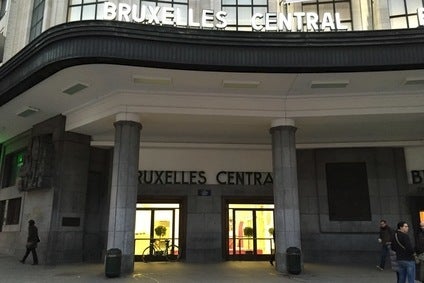
It’s taking an achingly long time, but is the European Commission (EC) finally waking up to the idea not everybody is falling over themselves to be subsumed into its gigantic superstate embrace?
The established hegemony of Brussels is starting to look a little creaky as, across Europe, mainly right-of-centre parties start to gain momentum and crucially, votes.
Go deeper with GlobalData


Access deeper industry intelligence
Experience unmatched clarity with a single platform that combines unique data, AI, and human expertise.
Only recently the Commission’s new president, Jean Claude Junker, elected in the teeth of massive opposition from the UK, survived a no-confidence vote of his fledgling tenure in the European Parliament.
Of course the outcome was never in doubt, but the very fact the massed ranks of the discontents had forced a vote so early, speaks volumes about the wave of unhappiness at what many perceive as Brussels’ headlong rush to federalism.
I mention this because I was at European automotive supplier body, CLEPA’s annual Aftermarket Conference in Brussels recently and quite out of the blue, we had this from the Head of Unit DG Move, Claire Depre.
If you ignore the Orwellian ‘Head of Unit DG Move’ title, what Ms Depre had to say, was for me at least, a startling first: “In the past, probably the EC has said perhaps we know everything and we will come with legislation,” she said, which had my rapt attention.
“At the same time we have Member States looking with suspicion at the European Commission. If we continue like that it will simply not work. The revolution is not tomorrow – it is today.”
If even the EC technocrats are coming up with that sort of language, could it be the burghers of Brussels are finally starting to understand they cannot simply go on appearing to appear aloof and armed with sheafs of yet more legislation?
Depre went on to address the issue of improving real-time traffic information – an area where pan-European coordination could be of real benefit to ordinary citizens of the bloated Euro club – but the fact she had strayed somewhat off the normal Brussels message I found fascinating.
And at a time when even Pope Francis himself – addressing what appeared to be an uncomfortable Juncker and the Parliament in its second – and costly – home of Strasbourg – appeared to fire a somewhat critical broadside at the EU and its relation to its constituency – maybe something is getting through.
However, a recent survey by UK association, the Society of Motor Manufacturers & Traders (SMMT) found a huge majority of its members wanted to stay in the European Union, but with the caveat of strict reform.
British Prime Minister, David Cameron, no doubt massively alarmed by the rise and rise of the United Kingdom Independence Party (UKIP), is making increasingly strident noises about Europe and whether or not London will choose to remain in the orbit of Brussels’ power.
The UK PM spoke recently to just-auto managing editor, Dave Leggett, at a Ford event to announce further expansion in engine manufacturing, where he stressed his support for a genuine single market in Europe.
Ford, Nissan, BMW et all, presumably all welcome the single market as a convenient and efficient way to conduct business, which would be much harder if Britain pulled up the drawbridge, but there’s a groundswell of public opinion out there against Brussels that seems to be growing.
What I find really interesting is the almost complete absence of a response from the left to the rise of the right. It could be many of the left’s natural supporters actually find an anti-EU stance to be in tune with their thinking, leading to the most unlikely of political bedfellows meeting full circle.
But you can’t run a country based on one issue alone and it remains to be seen just how far the left will be prepared to compromise some pretty sacred principles in order to ditch Europe, at least in the UK.
I did hear a genuine voice from the left in Brussels when I spoke to unashamedly socialist – the word is even in its official description – socialistische vakbond – ABVV union provincial president Rohnny Champagne.
Champagne heads up the Limburg region where Ford is about to wield the axe on the Genk plant, creating 4,300 direct redundancies, with possibly thousands more affected in the supply chain.
I asked him why he thought the right was having its message heard so loudly at the moment and after a moment’s reflection, he said: “Sometimes, when your wealth is under threat, everyone is looking more to themselves.
“It is more of a selfish reflex. When you show no solidarity, then you are almost immediately attracted to these parties.”
It’s certainly a valid point but the electorate appears to show no appetite for a return to even quasi-socialist politics, with Belgium itself, a bewildering mosaic of language-based parties, only recently returning a decidedly right-of-centre coalition.
The result has already seen a massive transport strike today (8 December), while Champagne revealed further massive walk-outs were planned by three major Belgian unions for next Monday as an anti-austerity movement gathers pace.
“We are trying to mobilise everyone and everything,” noted Champagne. “It is a national strike [15 December] – the impact should be massive.
“There will be no transportation, no trains, no buses, very little public life and industry will stop.”
That drastic action is set against some small green shoots of recovery in Europe – including some car markets which had shown almost never-ending decline – but the Continent is still wracked with economic challenges some of which Cameron highlighted only recently.
Belgium is echoing to a large extent its neighbour to the South West in that its organised labour regards industrial action as a powerful tool to rage against the machine, but it is perhaps the wider message to Brussels, which they are also articulating.
The old countries are certainly not out of the woods yet, but if even the tide of anti-Europeanism is lapping at the citadel of Brussels itself, perhaps the politicians will, for once, listen to the will of the people.



