
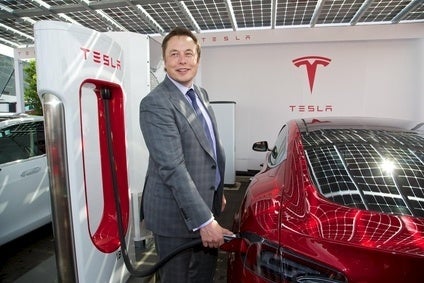
Why is Tesla’s share price falling? It’s a question that many are asking. Does the share price signal that Tesla is a busted flush? Far from it, says Dave Leggett.
In 2013, Tesla produced over 22,000 cars. That grew 50% to an estimated 33,000 units in 2014. With the new Model X SUV due mid-2015, Tesla is planning to increase production by another 50% this year at its Californian production base. Prospects sound pretty positive.
Go deeper with GlobalData


Access deeper industry intelligence
Experience unmatched clarity with a single platform that combines unique data, AI, and human expertise.
However, Tesla’s share price has gone into reverse lately. Yes, the forward looking, high-tech, sexy, West Coast, NASDAQ-listed electric car company so loved by investors has apparently fallen out of favour. A share price that reached a high of over $290 in September has now dipped under $200.
What’s going on? The first point to make is that the Tesla share price was probably pumped up way over where it should have been by an investor stampede that got carried away with the good news. Elon Musk apparently agrees. In September he said that the market is being “very generous” and that investors are giving Tesla a lot of credit for future execution. Quite. So, to some degree, we’re seeing something of a correction.
The good news came in a number of guises. Firstly, Tesla proved that it could build a credible electric car at moderately high volume in the shape of the Model S. The Lotus-inspired electric Roadster that came before turned a few heads, but the much higher volume Model S moved the game along in a big way. The promise of future models that could be built at even higher volume now had the benefit of a tangible, successful example. Tesla had shown that it can design, engineer and build a very credible electric car (and one with an impressive 250-mile range from a large, but well-packaged, 75kW battery). Other OEMs started to sit up and take notice.
Good news also came in the form of the company’s financial performance. Tesla has actually been around a while and start-ups tend to follow the acknowledged ‘jam tomorrow, not today’ route. Tesla is no exception, but this ‘start-up’ posted its first quarterly profit ahead of time in 2013. Investors got very excited again. An ambitious sounding timetable for the roll-out of future models had them positively salivating.
But those two things were not enough in themselves to propel positive market sentiment as powerfully as the share price suggested. The final sheen and additional wow factor comes in the shape of the company’s charismatic founder, talisman and deft manipulator of the media: Elon Musk. Musk, remember, is the archetypal maverick entrepreneur who has already made his fortune with PayPal, a future-looking business if ever there was one. So he’s surely business savvy. He can also run a car company and is decisive, gets things done (when the Tesla Roadster project went off track, he sacked Tesla’s CEO and took over himself).
This is a guy who certainly knows how to get media attention, by skillfully presenting a compelling story and vision. There are other strings to his spectacular projects bow, too. SpaceX develops and manufactures space launch vehicles with a focus on advancing the state of rocket technology. The eventual aim is to help with the colonisation of Mars. No lack of vision there then! A SpaceX rocket has already successfully supplied the International Space Station (even if the return to Earth went a bit, well, wrong). By the way, my favourite SpaceX mission involved a cheese.
Back on Earth, there is also a project for land-based very high-speed point-to-point travel involving vacuum filled tubes – Hyperloop. It’s another Elon Musk visionary project to add to the list.
Amid the growing media coverage of Tesla in 2013, the Tesla Motors share price steadily accelerated ($34 at the beginning of the year, $190 by September) as Tesla increasingly appeared to investors as a sign of the auto industry’s future while the big and established car companies, by comparison, struggled to generate excitement. Incredibly, Tesla’s market capitalisation – even after the recent share price decline – stands at almost half that of super-profitable BMW. Just bear in mind that Tesla sold 33,000 cars last year; BMW delivered 2m and has been around considerably longer. Even Elon Musk has acknowledged that the Tesla share price has looked excessive at times.
Has the Tesla bubble punctured and if so why?
If not burst, the bubble has certainly been deflated somewhat. The share price has fallen from a high of over $290 in September of last year to around $190 today. What has caused investor sentiment to move so quickly from buy to sell? One big factor is nothing to do with Tesla. The collapse in the price of oil has got investors worried about prospects for electric vehicles generally. With pump prices falling around the world, the real concern is that one of the main EV propositions – that you will save on fuel costs relative to burning fossil fuels – is dented somewhat. And market data showing that buyers in the US are starting to shift preferences to bigger engined cars and trucks reinforces the idea that market assumptions made a few years ago are being turned upside down. It’s not quite that simple, but there’s a new narrative starting to gain some traction and it’s a narrative that is not helpful to purveyors of electric vehicles, which tend to be looked upon much more favourably when pump prices are high.
This potentially big negative for Tesla’s products’ prospects causes investors to see the company in a different light. Suddenly the glass is half-empty, not half-full. Rather than being seen as a small, agile and potentially disruptive business with exciting prospects, the company is seen as low-volume, high-risk and lacking a track-record. Paradoxically, the lumbering big guys now look better with their lower risk business models, broader product portfolios and bigger resources. And any ‘bad’ news from Tesla is seen through that now more negative prism of no longer being a hot stock. “The next model is delayed? Slower sales reported in China? What were we thinking? I’m selling my Tesla stock.”
Programme delays
Besides unhelpful oil, there have indeed been delays to the new model programme. The Model X SUV is now expected to start production mid-2015 (with Q3 deliveries) and had originally been slated for late-2013 introduction. Okay, it is clearly late. That means the whole Tesla project is put back in time a little; profits will therefore be pushed further out in time also. But it is surely better that Tesla gets the execution of that model right, as good as it can be, and takes its time, if that is what is required. Better to delay than rush to the market. Bad reviews for a Tesla model would be severely damaging, all the more so if the criticisms reinforced a view that new entrant Tesla can’t quite cut it with the big boys. You can imagine the media angles: the brave little start-up punched above its weight, but has finally run out of steam, as we knew it would. Confidence would ebb.
So, Tesla is taking its time to get the product right. There’s nothing wrong with that as long as it is done for the right reasons and presented in the right way publicly.
Another concern for investors is the competition from established players. The worry is that the big car companies have indeed noted Tesla’s plans and are now going to enter the same markets with products that will reflect their bigger engineering departments, R&D and budgets, exploit vast scale economies and severely damage Tesla’s sales prospects. So, GM shows a Chevrolet Bolt EV concept in Detroit and alarm bells should be ringing, should they? Probably not, actually. As Musk has pointed out, more electric vehicles from more makers will boost consumer acceptance of electric vehicles generally. Would Tesla (with its Model 3) and Chevrolet (with something Bolt-based) be fighting for the same customers in the latter part of this decade? Maybe, but the customer base for electric vehicles ought to be growing by then. It’s a niche that will be getting larger, so much depends on just how big the market for electric vehicles can become.
The oil price? A low one is not helpful if you are making electric cars, of course. But we’re talking about decisions made at the margin. Whatever happens to the price of a barrel of oil, it will still be much cheaper to charge an electric car battery than fill up the tank with gasoline. Moreover, there are other reasons besides the crude ratio of gasoline-fill-up to electric-battery-charge-up price to buy an electric car. Tesla needs its vehicles to appeal on other criteria – like styling, interior finish – too. It did that with the Model S. And there are the brand values to develop. From what I have seen of Tesla customers so far, they don’t look like the types who would fight over a $50 TV on Black Friday. That’s perhaps a good customer base and associated brand image to work on.
Oil: What goes down must go up?
Crucially, let’s keep the price of oil in perspective. It is low now, but will it be as low in 2017, 2020? I doubt that. In the very long run the price of a finite resource that is being steadily exhausted is something of a one-way bet, even if there are periodic movements above and below the underlying upward trend. Burning fossil fuels is not something that regulators favour either, unless it’s to raise tax.
When the global economy is on a sounder footing and the Saudis have finished trying to make life difficult for marginal producers, something like ‘normal business’ on the international oil market will likely be resumed. By then, electric vehicles ought to be gaining market share (it won’t be huge, but from such a low base, volumes become much larger). They’re not just coming because consumers want them or they were thought of when the petrol pump price was high. Along with hybrids, the automakers need some vehicle electrification to meet market needs across the world for regulatory reasons. And Tesla Motors by then? It may not be independent any longer, but still carrying on its work. Perhaps what was Tesla will have become primarily a battery facilitator to the wider EV industry (the Nevada ‘Gigafactory’ project).
Musk has never made any secret of the fact that he is driven by the vision of clean, green vehicles. Tesla Motors was set up because Musk believed that the steps to achieving that end were more likely to come from a start-up than from existing automotive players. Tesla has worked with others – including Daimler and Toyota – before. Tesla’s relationship with other OEMs is something to watch, particularly in the context of the battery pack volume plans for the gigafactory in Reno (500,000 packs a year planned by 2020).
I suspect Musk will be very happy that Tesla has acted as a catalyst to promote the development of the electric car industry. Will Tesla’s share price head down further from where it is today? I suspect it will, driven down mainly by negative sentiment on the oil price. But Tesla’s share stock in three or four years’ time? I’d wager that it will be higher than it is today.



