
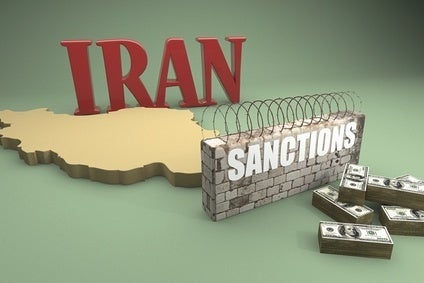
With all the hullabaloo surrounding the imminent nuclear talks deadline on 24 November – another one – between Iran and its suspicious Western negotiators – there is one implication of the Vienna talks that probably won’t even receive an airing.
Undoubtedly there are lofty affairs of State being undertaken in smoky corridors – if such things still exist – that have a genuine bearing on the peace and security of the world and these are rightly being put under the forensic spotlight of world attention.
Go deeper with GlobalData


Access deeper industry intelligence
Experience unmatched clarity with a single platform that combines unique data, AI, and human expertise.
These are serious issues that pit geopolitical concerns – given Iran’s borders – with a fear in Western capitals Tehran is seeking to enrich uranium with a view to developing nuclear weapons.
But from my recent conversations with the Scandinavian-Iranian Chamber of Commerce (SIC) in Gothenburg, a more human, but vitally important issue, is also at stake and it’s of equal life and death proportions.
Iran just happens to have one of the worst per capita vehicle mortality rates in the world, with some reports putting the shocking figures at 38,000 deaths and injuries for a population of 79m.
The World Health Organisation (WHO) estimates the number of fatalities at 25,000 – that’s 25,000 out of those 38,000 combined deaths and injuries – a stratospherically high number of people taking to the roads who end up in mortal accidents.
Iran is labouring under the yoke of draconian international sanctions – some may argue rightly so – but the trickle-down effect of that can be seen on its roads and in the poor quality of vehicles on them.
The country is eager to participate in overseas co-operation to address its chronic safety issues, but is hamstrung by a raft of sanctions-led obstacles acting as gigantic barriers to tackle its awful record.
The recent modest thaw in hitherto glacial relations between Tehran and its counterparts in Brussels and Washington – much to the hawkish United Against Nuclear Iran’s (UANI) suspicions – have however seen a tiny melting in hitherto impregnable positions.
That slightly ajar door has been the result of a more doveish approach from new Iranian President, Hassan Rouhani, who will be hoping the nuclear talks with the so-called P5+1 group: the US, UK, France, Germany, Russia and China, as well as the European Union and Iran, will yield positive results that some estimate could see auto continue to benefit from and indeed improve upon, the US$500m of vehicle-specific business to be generated.
Already, France has started to beat an increasingly loud drum through visits by its automotive supplier body, FIEV and business association, MEDEF, while Scandinavian component organisation, FKG, is mulling a similar trip early next year.
The wheels are starting to turn – despite reticence from UANI and more hardline opponents – but away from the grandstanding there is a real chance for the politics of all this to make a difference to ordinary Iranians – who just want to get on and earn a living like the rest of us – and have access to basic safety standards.
SIC president, Reza Khelili-Dylami, told me from Stockholm about just one extraordinary statistic that appears remarkably easy to address; namely, some 10,000 lives could be saved every year in Iran through the simple expediency of fitting airbags and improving brake systems.
“Most of the accidents [which] happen in Iran, happen with bad brake [s] and old cars [for example],” he said.
“So we must change something [with] more than 50%-60% of the Iranian car [s], because the oldest car is more than 30 years old. We have old English Hilman [s] – we must change the old cars.
“I have been in Iran [this week] and we have some Cadillacs and Chevrolets more than 45 years old – this must change.”
Only in Cuba have I ever seen cars of such vintage – and those are mainly ancient American Studebakers and Pontiacs liberally sprinkled with a variety of Soviet-supplied vehicles – but even on the sanction-hit Caribbean island deaths per 100,000 equal around seven compared to the eye-opening figure of 34 for Iran.
Television reports cite the frequency of so-called ‘light cars’ in Iran that despite being unsuitable for motorways are nonetheless used on them. Such vehicles reportedly come ‘equipped’ with light bumpers and bonnets only deemed advisable to use in urban environments – not something of which many people appear to take notice.
This may seem a monumentally simplistic assertion, but it appears at first glance that lives in Western, ‘mature’ markets seem to be of more worth simply because of disposable income, than in emerging markets such as Iran.
That’s clearly not the case – manufacturers would vehemently contest it – but the accident rates need to be addressed with some urgency even if it means squaring the circle of affordabilty and safety.
There are some who would argue Iran – or Persia in its former incarnation – was a society far more civilised from the dawn of time than we in the so-called developed world ever were at a comparable period – but the very basic and elemental provision of vehicle safety seems to be being delivered on a two-tier basis.
As the powerbrokers of the world gather in Vienna for talks of the utmost seriousness, will the debate around the effect of sanctions on ordinary citizens far removed from the machinations of global politics, even be deemed worth of consideration?
It’s easy to be idealistic and demand the same safety standards on a global basis, but as passive and active safety systems, autonomous cars and smart technology allowing cars to ‘talk’ to each other, gather traction in the West, is the consumer at the other end having a fair hearing?
No-one is claiming all the shiny gadgets being enthused over in the West can be provided without any cost to emerging markets. But basic safety?
The worldwide safety body, Global NCAP, maintains it would take just US$100 to implement elementary safety standards, with chairman, Max Mosley, also insisting: “Applying the UN’s minimum crash test standards to all passenger car production worldwide is a key recommendation of the Global Plan for the UN Decade of Action for Road Safety.”
But you can see the other side here too. Without low-cost models entering emerging markets, maybe those countries would simply not have access to any sort of four-wheeled vehicles and would be riding two-wheeled ones instead.
There’s clearly no free lunch – the commercial imperative and therefore opportunity – is plain to see for manufacturers – but there are huge possibilities in Iran for example for suppliers and OEMs to make a real safety difference – and help their bottom line to boot.
French and Scandinavian suppliers, maybe who knows, even some British and American ones, will be eyeing events in Vienna with huge interest and crossing their fingers some more modest sanctions-lifting will mean Iran finally has access to basic safety standards in automotive and aerospace we take for granted.
To end on a sobering statistic, the WHO estimates nearly 3,400 people die on the world’s roads every day, with 1.3m killed every year.
The United Nations has agreed 2011-2020 will be the global Decade of Action for Road Safety; isn’t it time far more attention was turned to those without the financial clout of the West to make that Action Decade a reality?



