
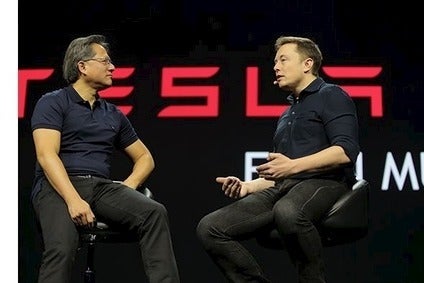
Tesla founder and CEO Elon Musk has told a conference in the US that he can foresee a time when driving cars may be outlawed.
Talking to Nvidia’s CEO Jen-Hsun Huang at Nvidia’s GTC conference in California, Musk said that he believes autonomous cars will eventually become “normal”.
Go deeper with GlobalData


Discover B2B Marketing That Performs
Combine business intelligence and editorial excellence to reach engaged professionals across 36 leading media platforms.
He was reminded by Huang about his past remarks that artificial intelligence (AI) could be potentially more dangerous than nuclear weapons [Musk stressed the word potentially] and then asked how removing the human input to driving can play out in the automotive arena.
“Autonomous cars are a narrow form of AI,” he said. “To do it to a degree that is much safer than a person is much easier than people think. It will become normal, like an elevator. We used to have elevator operators and then simple circuitry developed so that we no longer needed someone to operate the elevator. You just press a button. The car will be like that.”
He also offered the view that driving could be outlawed for safety reasons. “I think in the future people may outlaw driving cars because it will be seen as too dangerous. You can’t have a person driving a two-tonne death machine.”
Huang also suggested that safer cars less likely to collide could mean that future cars would have some of the weight added by safety measures such as crash protection structures and airbags taken out, for added efficiency.
Musk agreed that could come eventually, but he also said such a scenario is a long way off.
“We’re a long way from that. There will be legacy cars on the road for a very long time. There are around 2bn vehicles on the road [globally] and the capacity of the world’s auto industry is around 100m vehicles a year. If all vehicles made and sold were autonomous from now it would take twenty years top convert the world’s fleet. The transition will take time.”
“It’s the same with electric vehicles,” he added. “It would still take some time to work through and change the fleet – twenty years if all the vehicles made were electric, and right now it’s less than 1%…”
Musk also said that while there were areas of autonomous driving that were relatively straightforward, there were some difficult areas that would take time to develop computing solutions. “It’s about the camera and sensor hardware capabilities and the software that works with that,” he pointed out. “The P85D has a 360-degree 5-metre sensor sweep and you can do a lot with that, add more software updates, but there are limits.
“When we look at driving conditions and autonomous driving, highway environments are generally okay. And so are very low speeds, up to 10mph, where ultra-sonics detect anything and you avoid hitting anything at all. You can stop within the range of the ultra-sonics. It gets much more complex when looking at the urban environment and vehicle speeds of around 10-50mph where you can have more unexpected things happening – for example, a road closure, children playing at the side of the road, a manhole cover open, bicycles in the mix. When you get above that, say at 50mph in a freeway environment, it gets easier again with the set of possibilities much reduced.
“So, highway cruise is easy, low speed is easy and intermediate is hard. Being able to recognise what you are seeing and make the right decision in the urban environment in that 10-50mph zone is the challenging portion.”
Musk added that the challenges are well known and understood. “I almost view it as a solved problem,” he said. “We know exactly what we need to do and we’ll be there in a few years.”
“Just like Mars!” quipped Huang.
Musk went on to outline how he sees the future timeline for the introduction of more autonomous cars and the regulatory framework surrounding them.
“We’ll take autonomous cars for granted in quite a short period of time,” Musk maintained. “It’s amazing how comfortable you get with it and how quickly.
“From the point at which the [autonomous] car is safer than a person, there is probably another 2-3 years after that of the regulators wanting a large amount of statistical proof that it is not merely as safe as a person, but much safer. So you can run it in shadow mode and say ‘this is what the computer would have done in all these circumstances. Was there a crash or was there not? What are all the false negatives and false positives?’ And then with a large population group you can make a really clear statistical argument with the regulators and then they will digest it for a while, see if they agree with it and then I think they will because the evidence will be overwhelming.”
GERMANY: Self driving cars “uncharted waters” – BMW




