
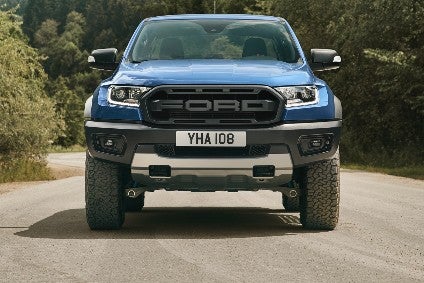
Think no-one would pay almost fifty thousand pounds for a Ford? Think again. And it isn’t only the Mustang Bullitt that Ford of Britain is doing good business with. The high priced Raptor version of the Ranger is selling well in a sub-segment where even Mercedes-Benz hasn’t been able to gain traction.
The Raptor lists at GBP47,874 but you can push the spec close to the fifty grand mark. The as-tested model came with for example GBP720 worth of optional ‘Ford Performance Blue’ paint and looked all the better for it too. While the pricing sounds high for what is in essence a commercial vehicle built in a low-cost country, the Ranger range-topper has had the magic wand of latest tech, safety and luxury gear waved over it.
Go deeper with GlobalData


Discover B2B Marketing That Performs
Combine business intelligence and editorial excellence to reach engaged professionals across 36 leading media platforms.
Standard equipment includes all-terrain tyres, a 150mm wider track, unique bumpers, alloy side steps, Fox Pro shock absorbers (you notice how well they work when on gravel), four towing hooks, a load-box roller shutter, a soft-closing tailgate, Ford’s Sync 3 system with an eight-inch screen, a heated windscreen and special suede trim plus blue and red interior detailing.
The allure of the Raptor sub-brand makes people forget any thoughts they may have about Fords not being the equal to German brands. The Mercedes X-Class is the best example of that. Theoretically there could be an AMG equivalent but Daimler doesn’t seem to believe it would sell. What then makes a Raptor special? It must surely start with the name, and the looks. There are decals on the sides and tailgate, while the brutal looking grille with FORD in large font helps too.
One global Ranger but no Raptor for USA
North America’s locally built Ranger doesn’t come with a diesel option so the only Raptor available there is the original: the wider and taller, and V6 turbo-powered F-150. For all its talk of leveraging the Mustang name to create demand for an expensive electric SUV (that’s still twelve months away), Ford is missing a trick by not creating a gasoline Ranger Raptor for the US and other regional markets.
One of the issues is the company wanting to make sure that the smaller of its two main pick-ups doesn’t challenge the F-150 Raptor. Even if it’s hard to think of the 5,362mm long (in double-cab form) Ranger as anything but a big vehicle. This is close to being too long for Britain and the 2,180mm width can also be a problem now and then. It’s ironic that the owners of such a tough looking vehicle need to treat it extra cautiously in narrow streets. And then there is the unfathomable omission of parking sensors for the front end. That’s about the only thing which made me question the premium pricing.
Europe’s class leader
The class in which the Ranger competes contains a lot of vehicles: everything from the Toyota Hilux and Mitsubishi L200/Triton to the Nissan Navara, Volkswagen Amarok and of course the X-Class. Ever seen a Renault Alaskan? Nor me. It’s not offered in RHD form but even in France it’s rare. None of those is available in the world’s number one market for pick-ups. Instead, the Toyota Tacoma, Jeep Gladiator plus GM’s Chevy Colorado and GMC Canyon and to a lesser extent the ancient Nissan Frontier are the other big sellers in the US.
The Federalised Ranger, which has some exterior differences, was revealed at the Detroit auto show in January 2018. Series production commenced at Wayne (Michigan Assembly) in October last year, the truck being new for the 2019 model year. Four-door SuperCab or SuperCrew cab configurations are available and there is also an FX4 Off-Road Package. All Rangers for the US and Canada are powered by a turbocharged 2.3-litre four-cylinder EcoBoost engine, with a ten-speed automatic gearbox standard. Both rear- and four-wheel drive are offered.
The Ranger is claimed by Ford of Europe to be the number one model in a 50-market regional segment, something of which Daimler in particular will be envious. The X-Class, launched to great fanfare, hasn’t found much success in the model’s main markets of Europe, Australasia and southern Africa, all places where the Ford is doing especially well. Rumours even claim that Mercedes’ Nissan-based pick-up will be dropped, plus its new CEO wants to loosen ties with the R-N-M Alliance.
Nine years young and a few yet to go
Ford’s global pick-up has been around in its present generation since October 2010, the public seeing it for the first time alongside the equally new Mazda BT-50 twin at the Sydney motor show, although build didn’t commence until mid-2011. These models introduced the T6 architecture. This separate chassis platform has since been put to use by the Endeavour/Everest SUV and will also be the basis of the yet to be seen Bronco, another SUV which will be mainly for North America.
The Ranger would be built in Thailand, South Africa and Argentina, Ford stated at the vehicle’s launch. Since then, FTM, which is Ford of Thailand’s own plant as opposed to the AutoAlliance Ford-Mazda facility, has also gained production. Both facilities are in Rayong. Knocked down assembly commenced in Nigeria two years ago, the Lagos site having an annual capacity of 20,000 vehicles. Little by little, this vehicle has become a much-made model on multiple continents.
The Ranger’s successor as well as the future VW Amarok will be T6-based too when they appear in perhaps three years’ time: Mazda has been dropped as Ford’s partner, replaced by Volkswagen. The Japanese company has instead asked Isuzu to supply it with a Thai-built replacement for the BT-50.
A petrol engine too for the next Raptor?
The potential for a Raptor variant in Australia – the Ranger is the best selling Ford in that country – is understood to have persuaded Ford Motor Company to make such a vehicle part of the next Ranger line-up worldwide. Which means a gasoline engine for North America and certain other places. The biturbo four-cylinder diesel should remain for other markets, but in the US and neighbouring countries, a V6 turbo seems likely.
Before the arrival of a revised line-up in January this year, up to four different engines had been offered in the Ranger: 2.0-litre four-cylinder diesel, 2.2-litre four-cylinder diesel, 2.5-litre four-cylinder gasoline or 3.2-litre five-cylinder diesel. Five- and six-speed manual gearboxes featured, as did six-speed and ten-speed automatic transmissions.
Ten-speed auto and 500Nm
The changes announced a few weeks into 2019 consisted of a revised 213PS and 500Nm version of Ford’s 2.0-litre biturbo EcoBlue diesel. This replaced the 3.2-litre five-cylinder engine, in European countries at least and is standard for the Raptor.
The 2.0 EcoBlue also comes with outputs of 130PS and 340Nm or 170PS and 420PS: each of these has a single turbocharger. At the same time, the 2.2-litre diesel was phased out. As for transmissions, the ten-speed automatic is optional for the 170PS and 213PS engines but standard for the Raptor. Other revisions included the addition of Pre-Collision Assist with Pedestrian Detection and Intelligent Speed Limiter as standard. Incidentally, the ten-ratio gearbox is the same one which features in the F-150 and Mustang.
Built in ZA for EU markets
More than eight years ago, Ford revealed plans for build of up to 110,000 units a year of this light truck at its Silverton plant near Pretoria. The South African factory, which also supplies the truck to European markets, began making the updated model during the first quarter of 2019. Ford of Europe told us back in July that Silverton would be introducing a third shift due to high demand for the Ranger.
The Raptor hasn’t been part of the line-up for very long, its pre-facelift debut being announced in February 2018. Ford gave it upgraded suspension (coil springs replace the Ranger’s usual leaf-sprung back end) and the then-new bi-turbo diesel 2.0-litre engine as well as the ten-speed automatic transmission. The original 157kW (213PS) and 500Nm power and torque numbers did not change when the facelifted line-up arrived in Europe this summer.
The performance of this truck isn’t anything special, zero to 62mph taking 10.0 seconds but at least top speed is in three figures (106mph) even with that huge frontal area and suspension lift. The thing weighs in excess of two and a half tonnes, which is one of the reasons why the CO2 average is 233g/km and the fuel consumption I saw was a mere 33mpg. If you don’t spend too long on motorways, the Raptor can return closer to 40mpg.
Dynamics
Even with all that weight and width, this big vehicle can be hustled along A roads, even if the weather is foul. I was expecting body roll to be spectacular yet somehow it isn’t and the damping, which must have been set up for off-road conditions so good is it on a loose surface, also surprises on-road. If only it had been possible to gear the steering with fewer turns. Incidentallyt, the brakes are better than the norm for this type of vehicle: not all pick-ups in the size class have discs at the back.
Think of the Raptor as an extreme pick-up rather than a road car and its dynamics are actually really very strong and some slack in the steering can be tolerated. In fact that’s a good rule of thumb for the whole vehicle. Don’t regard this as a luxury off-roader because it’s nothing like such a vehicle. If Land Rover built a pick-up it wouldn’t be like this.
Summary
The Raptor is a tamed off-road racer, sadly without the mad pace. And that would be the one thing I would change about it: somehow get the weight out and add power.




