
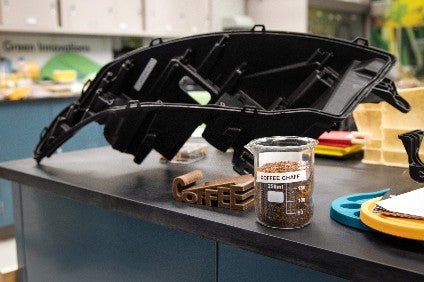
A byproduct of coffee bean roasting at McDonald’s will soon be used by Ford to make vehicle parts such as headlamp housings.
The two household names have teamed up to use millions of pounds of coffee chaff – the dried skin of the bean – which naturally comes off during the roasting process.
Go deeper with GlobalData


Discover B2B Marketing That Performs
Combine business intelligence and editorial excellence to reach engaged professionals across 36 leading media platforms.
A “significant portion of that material” will be converted into a durable material to reinforce certain vehicle parts. By heating the chaff to high temperatures under low oxygen, mixing it with plastic and other additives and turning it into pellets, the material can be formed into various shapes.
The chaff composite meets the quality specifications for parts like headlamp housings and other interior and under hood components. The resulting components will be about 20% lighter and require up to 25% less energy during the moulding process.
Heat properties of the chaff component are significantly better than the currently used material, according to Ford. This is the first time the automaker has used coffee bean skins to convert into vehicle parts.
“McDonald’s commitment to innovation was impressive to us and matched our own forward thinking vision and action for sustainability,” said Debbie Mielewski, Ford senior technical leader, sustainability and emerging materials research team.
“This has been a priority for Ford for over 20 years, and this is an example of jump starting the closed loop economy, where different industries work together and exchange materials that otherwise would be side or waste products.”
McDonald’s is expected to direct a significant portion of its coffee chaff in North America to Ford to be incorporated into vehicle parts.
“Like McDonald’s, Ford is committed to minimising waste and we’re always looking for innovative ways to further that goal,” said Ian Olson, senior director, global sustainability, McDonald’s.
“By finding a way to use coffee chaff as a resource, we are elevating how companies together can increase participation in the closed-loop economy.”
The collaboration with Ford and McDonald’s is the latest example of the innovative approaches both companies take to product and environmental stewardship.
The project also involves Varroc Lighting Systems, which supplies the headlamps, and Competitive Green Technologies, the processor of the coffee chaff.
Ford is progressing toward a goal of using recycled and renewable plastics in vehicles globally, with an increasing range of sustainable materials.
McDonald’s is on its way to sourcing 100 percent of its consumer packaging from renewable, recycled or certified sources by 2025. In addition, it is helping develop a recyclable and/or compostable cup through the NextGen Cup Consortium and Challenge. Both efforts are part of its Scale for Good initiative, a global commitment to use its size and scale to drive meaningful change.
McDonald’s and Ford plan to continue exploring ways to collaboratively use waste as a resource, while furthering their sustainability goals.




