
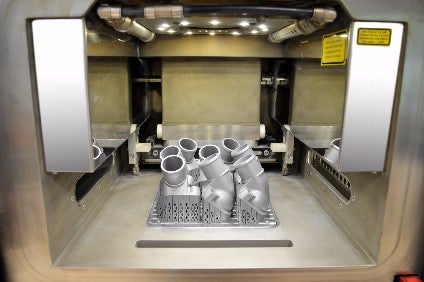
Daimler's Mercedes-Benz Trucks said it had taken 3D printing a stage further with the first spare part made of metal.
A thermostat cover for older model trucks and Unimogs passed all quality checks and is now on sale.

Discover B2B Marketing That Performs
Combine business intelligence and editorial excellence to reach engaged professionals across 36 leading media platforms.
Parts and service chief Andreas Deuschle said: "We ensure the same functionality, reliability, durability and cost-effectiveness with 3D metal parts as we do with conventionally produced parts."
The company is also using 3D printing for plastic parts and has found the process particularly suitable for smaller batches.
Metal parts have very high strength and thermal resistance, and the process is particularly suitable for the production of mechanically and thermally stressed components in small numbers. Metallic components can be produced with any geometry and in any numbers.
3D replacement parts production began with rarely ordered aluminium parts which have almost 100% density and greater purity than conventional die cast parts. Production requires no cost intensive development work or procurement of special tools. Peripheral engine, in engine, cooling system, transmission, axle and chassis parts are all possible, especially when they have complex structures.
3D-printed metal parts in small numbers can be produced cost effectively as infrequently requested replacement parts, special parts and for small and classic model series, Daimler said.
"This gives us completely new possibilities for offering our customers spare parts rapidly and at attractive prices, even long after series production has ceased," Deuschle said. 3D metal printing might allow decentralised and therefore much faster, local production directly. This would further improve parts availability: expensive warehousing and the associated, complex transport processes would be unnecessary, with shorter delivery times.
In contrast to selective laser sintering (SLS) used for plastics sector, 3D printing of metallic components uses Selective Laser Melting (SLM). For the thermostat cover, powdered aluminium/silicon material (ALSi10Mg) is applied in individual layers and melted by an energy source – usually one or more lasers. When one layer is completed, a new layer of powder is applied automatically and the melting process is repeated. The process is repeated as needed. Thanks to the layered structure, it also offers a level of geometrical freedom that cannot be matched by any other production method.



