
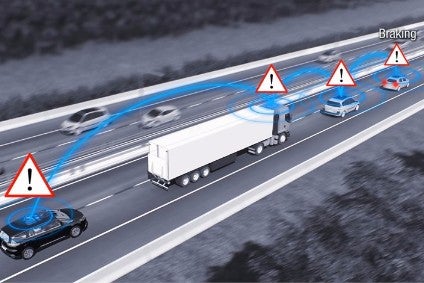
Renault is working with the European Union (EU) on its V2V and V2X Scoop programme to test new technology on its Mégane vehicles and is in the process of recruiting fleet partners to be part of the next-generation project.
Scoop is a pilot project for the deployment of cooperative intelligent transportation systems. The EU project facilitates trials of future vehicle-to-vehicle (V2V) and vehicle-to-infrastructure (V2X) connectivity solutions in real-world driving conditions.
Go deeper with GlobalData


Discover B2B Marketing That Performs
Combine business intelligence and editorial excellence to reach engaged professionals across 36 leading media platforms.
It is carried out alongside a range of partners in France, including the French Ministry for Ecological and Inclusive Transition, regional authorities, infrastructure operators, universities and research centres.
“Our main goal is to offer our fleet customers cars that are safer on the roads and improve the flow of traffic,” said Renault Scoop project manager, Christine Tissot.
“These vehicles ‘talk’ to each other and warn each other in real time of any hazards, slow traffic or accidents on the road ahead.
“Infrastructure firms like French motorway operator, SANEF also send information to compatible cars about traffic, roadworks, speed limits, accidents and upcoming hazards.”
The fleet of Scoop-enabled Méganes uses technology which will be fitted to tomorrow’s autonomous, connected cars. This includes sensors and computers that gather and analyse vehicle data such as speed, steering wheel angle, possible tyre grip problems in relation to the weather, windscreen wiper operation and deployment of airbags.
If a problem is detected, the car’s on-board computer automatically sends a warning message to other Scoop-enabled vehicles and to units positioned along motorways.
These units then notify emergency services if a major incident is detected. In the pre-deployment phase, the units will be installed along 2,000km of roads in the greater Paris region, along the A4 motorway, in the Isère department in Eastern France, the Bordeaux ring road and Brittany.
The on-board computer, which issues the warning messages, uses a high-performance wireless communication protocol harnessing ITS G5 technology (Intelligent Transportation Systems), operating on a dedicated frequency (5.9GHz). These systems have been developed for moving objects and offer a range of up to 1,000 metres. The protocol systematically verifies the authenticity of each message and operates quickly in real time to avoid any collisions.
It also guarantees data is processed and held anonymously to protect users’ privacy.
“Groupe Renault is currently in talks with several French companies to include Scoop-enabled Méganes in their vehicle fleets,”added Renault SVP, Nadine Leclair.
“In this early phase we are seeking fleet partners who want to use the latest connected technology to test new ways of keeping their employees safer on the road. Under the Scoop project, trialling these fleet vehicles now also means they are part of building a new ecosystem for Europe’s autonomous, connected cars of the future.”
The EU’s Scoop project started in 2014 and has now entered an active trial phase using 1,000 Renault Méganes produced at its Palencia facility in Spain.




