
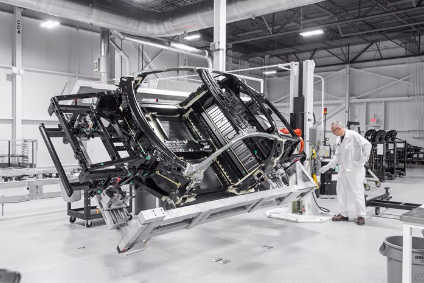
Honda has announced that its new Performance Manufacturing Centre (PMC) in Marysville, Ohio will begin series production of the next-generation Honda NSX supercar in late April 2016. Deliveries for European customers are due to start in autumn 2016.
The Performance Manufacturing Centre is the exclusive newly-built global manufacturing facility for the all-new NSX. Conceived to innovate both the means and the methods of producing low-volume specialty vehicles, Honda says the PMC meets the challenges of combining next-generation craftsmanship and quality through fresh approaches to vehicle construction, paint, assembly and quality confirmation.
Go deeper with GlobalData


Discover B2B Marketing That Performs
Combine business intelligence and editorial excellence to reach engaged professionals across 36 leading media platforms.
The NSX is constructed entirely in-house at the PMC, which was a clean-sheet development designed around the NSX’s unique multi-material body and aluminium-intensive spaceframe.
“All of the innovative thinking and hard work that has gone into the creation of this state-of-the-art manufacturing facility has fulfilled our goal to build a supercar in America,” said Clement D’ Souza, the engineering large project leader of the PMC, who managed the creation of the facility. “The incredible passion and challenging spirit of our highly skilled associates is readily seen in the world-class quality and incredible dynamic performance of this next generation Honda NSX supercar.”
The PMC employs approximately 100 Honda workers who support or are directly engaged in body construction, painting, assembly and quality confirmation.
The aluminium-intensive spaceframe is created with 100 percent robotic MIG welding, the first time this technique has been used in the automotive industry, Honda claims. Eight weld robots apply 860 MIG welds to the spaceframe, ensuring precise and repeatable welds, resulting in a highly accurate body assembly process. 360-degree-rotating rotisserie-style body fixtures aid precision by turning the body during the process to provide optimal access for the robotic weld arms.




