
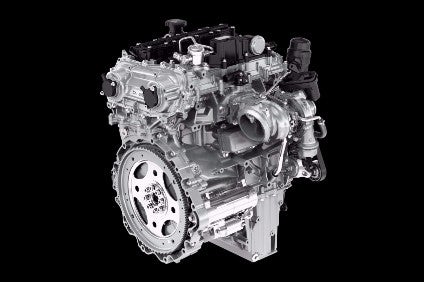
Tata Motors’ luxury vehicle unit Jaguar Land Rover is expand its in-house-developed powertrain family with a four cylinder Ingenium petrol engine now in production at its GBP1bn Engine Manufacturing Centre in Wolverhampton.
Designed, engineered and manufactured in the UK, these are the most advanced engines the company has ever developed and will deliver up to 25% more power than the engines they replace (developed under Ford ownership) and offer fuel consumption reductions of up to 15%.
Go deeper with GlobalData


Discover B2B Marketing That Performs
Combine business intelligence and editorial excellence to reach engaged professionals across 36 leading media platforms.
JLR has also developed a “revolutionary” advanced automatic transmission that will both improve the efficiency of future vehicles and expand their all-wheel drive capability. The GBP30m advanced research project, TRANSCEND, uses an innovative ultra-wide ratio spread (20:1) that integrates low-range gear box, dual-clutch and hybrid technologies to deliver claimed new levels of off-road performance and fuel economy improvements of nearly 10%.
Engineering chief Nick Rogers said: “Environmental innovation is at the heart of our strategy to dramatically reduce emissions up to 2020 and beyond. With the Ingenium family of powertrains and advanced research projects such as TRANSCEND, future Jaguar Land Rover vehicles will emit significantly less CO2. By 2020, new technologies will help us reduce our CO2 emissions by a further 25%.”
Ingenium petrol
The petrol engine includes an electrohydraulic valvetrain, integrated exhaust manifold and twin scroll turbocharger with ceramic ball bearing technology.
Rogers said: “Ingenium has been developed as a modular family of powerful, efficient and refined all-aluminum petrol and diesel engines. All Ingenium engines deliver benchmark low levels of friction, contributing to inherently good efficiency and refinement.”
Using a common architecture based on a 500cc per cylinder displacement delivers both maximum flexibility and scaleability. This enables a range of derivatives to be developed to suit applications as diverse as sports saloons and luxury SUVs.
Following the launch of the two-litre four-cylinder diesels in 2015, these advanced petrol engines become the latest Ingenium engines to enter production and will be available from 2017.
TRANSCEND transmission
Weighing around 20kg less than existing eight-speed automatics, TRANSCEND could be used in longitudinal rear-wheel drive and all-wheel drive vehicles.
Rogers said: “TRANSCEND demonstrates Jaguar Land Rover’s commitment to original research that improves the driving experience and the environmental performance of our vehicles. It will make manoeuvring and off-road use easier than ever before for drivers whilst also improving on-road vehicle dynamics and CO2 emissions.”
With part funding from the UK government, the TRANSCEND programme aims to rebuild the UK’s transmission production – through investment in processes to develop lighter components as well as more energy-efficient manufacturing production – and promote the export of British hybrid vehicle technologies.
Low emissions future
Jaguar Land Rover’s vision for reducing emissions and improving fuel efficiency is to make improvements in powertrain, continue its leadership in vehicle light-weighting and improve vehicle energy conservation.
Since 2008, it has doubled the number of powertrain engineers and invested in the research of a range of future powertrain solutions. This team is developing the technology that will help deliver a further 25% improvement in CO2 emissions in the next five years.
It is committed to introducing electrification and has confirmed its electric future with an entry for Jaguar in the innovative FIA Formula E Championship. This investment will push the boundaries of electrification technology and provides a real-world, fast-track test bed for future Jaguar Land Rover electrification technology, transferring it from track to road.




