
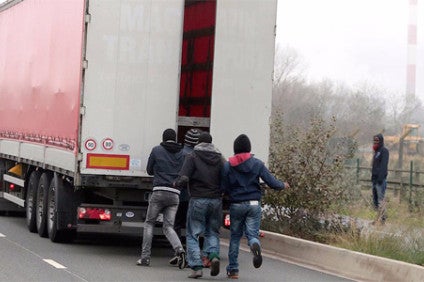
UK Freight Transport Association (FTA) has strongly criticised proposals by French Presidential candidate, Alain Juppé to move border controls in Calais to Dover in Kent as a recipe for “cross-channel chaos.”
Yesterday (24 October) saw bulldozers move into the Calais camp, home to at least 8,000 migrants fleeing Middle East unrest and desperate to reach the UK stowing away on lorries crossing the English Channel.
Go deeper with GlobalData


Discover B2B Marketing That Performs
Combine business intelligence and editorial excellence to reach engaged professionals across 36 leading media platforms.
The FTA – along with the British Road Haulage Association (RHA) has consistently highlighted the issue of danger to drivers engendered by some migrants who have shredded truck sides with knives and fashioned branches into spears to hurl at vehicles.
The appalling conditions in the Calais camp – as well as the wider issue of the political unrest fomenting in the Middle East acting as fuel for the migrant exodus north – have become a key issue for next year’s Presidential elections in France as candidates jockey to curry favour with public opinion concerning the ‘Le Touquet’ agreement allowing border controls to be undertaken in northern France.
Juppé is specifically calling for the Le Touquet agreements to be radically overhauled, putting the onus on the British to deal with the migrant crisis on their own shores. “Renegotiate the Le Touquet deals signed by [former French President] Nicolas Sarkozy,” said Juppé, himself a previous Prime Minister.
“A system in which the British authorities, decide on French territory, at Calais, which people they want to take in at Dover, can not stand.”
Part of the turmoil in Calais may also have been triggered by a perception the UK will introduce tougher immigration controls in the wake of its decision to leave the European Union (EU), leading to migrants making extra efforts to smuggle themselves aboard cross-channel transport.
The FTA has consistently called for the Le Touquet Treaty to be maintained following Britain’s vote to leave the EU in June. The agreement, which has been in place since 2003, allows Britain to carry out checks in Calais to stop migrants trying to get to Britain, while French counterparts can do the same in Dover.
“Moving controls back to Dover would cause cross-Channel chaos and would significantly impact on the frequency of crossings,” said FTA EU affairs manager, Chris Yarsley.
“The layouts of both the Port of Dover and the Folkestone Channel Tunnel terminal would need to be completely redesigned and the number of sailings and shuttles would be limited to the rate at which passport and immigration checks could be completed upon arrival.”
FTA says the arrangement is mutually beneficial and any change would be a signal to people smuggling gangs to continue targeting commercial vehicles and their drivers in an effort to reach Britain via the Port of Calais and the Channel Tunnel.
“Scrapping the Treaty and the juxtaposed controls would be short-sighted and counter-productive,” added Yarsley. “FTA repeats its long-held message attention should be placed on securing the road network on the approaches to the Channel terminals rather than moving the border.
“Under international obligations, France is responsible for all asylum claims made on its territory and it should put in place suitable arrangements to allow this to take place.”
The 8,000 migrants in Calais – the FTA estimates there are 10,000 – will now be dispersed around France but concerns have been voiced many of these will simply return to Calais in a bid to make it across the English Channel using lorries either on ferries or Le Shuttle train services
The Pas-de-Calais Prefect – Fabienne Buccio – has given migrants 72 hours to leave the Calais facility.




