Geely-owned Volvo Cars has withdrawn its financial guidance for this year on what it described as an increasingly challenging market situation. It said a deteriorating near-term market outlook has resulted in lower-than-expected sales and a weaker full year outlook.
Go deeper with GlobalData


Discover B2B Marketing That Performs
Combine business intelligence and editorial excellence to reach engaged professionals across 36 leading media platforms.
Therefore, it said Volvo Cars will not fulfill the previous full year 2026 outlook statements on volume and cash flow.
The decline is primarily driven by further deteriorating market conditions in China and slower than expected recovery in the US, while Europe remains resilient, the company said.
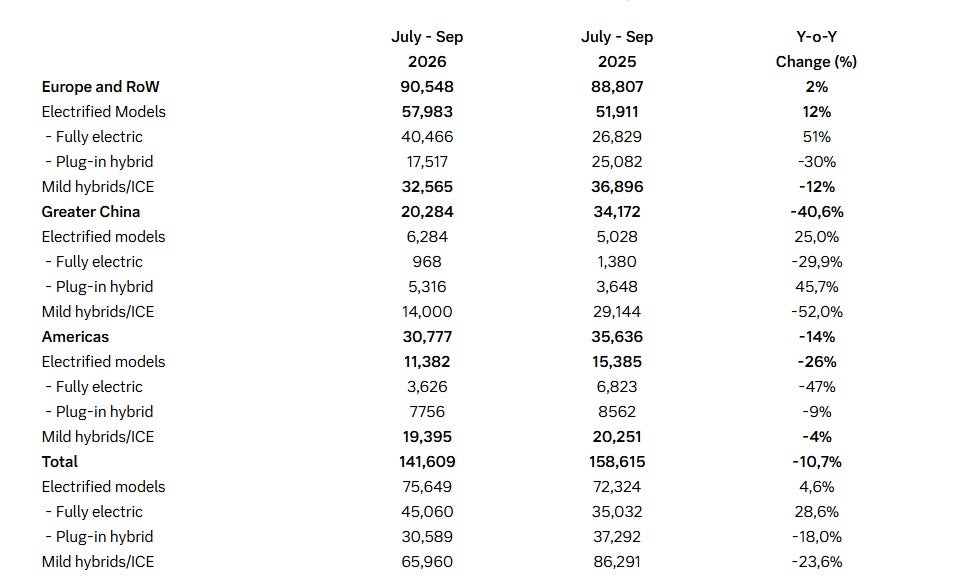
Volvo Cars reported global sales of 141,609 cars in the third quarter of 2026, down 10.7% from the same period last year.
The company said these developments will also have a ‘significant negative impact on third quarter core earnings and cash flow, beyond the previously communicated headwinds on raw materials, FX and increased amortisation and depreciation levels’.
However, it also said that as a result of the increased market uncertainty, ‘Volvo Cars has also taken the decision not to provide any updated short-term forward-looking statement’.
The company said it is taking further ‘decisive actions to improve and accelerate execution of our strategic roadmap in this challenging environment and will share more details when it reports its third quarter financial results on October 23’.
Q3 sales down 11%
Volvo Cars reported global sales of 141,609 cars in the third quarter of 2026, down 10.7% from the same period last year.
Volvo Cars sales during the third quarter were impacted by a further deterioration in market conditions in China, where industry volumes remained under significant pressure, as well as a slower-than-expected recovery in the US.
“The market downturn in China showed no signs of easing, and the recovery in the US premium segment remained below our earlier expectations,” said Erik Severinson, Chief Commercial Officer at Volvo Cars. “This impacted our third-quarter sales, and the same challenging market conditions have led third-party analysts to lower their sales forecasts for the premium car market for 2026.”
At the same time, Volvo said performance in Europe remained resilient, supported by strong demand and order intake for fully electric cars.
The company’s sales of fully electric models grew by 29% and accounted for 32% of all cars sold. Sales of electrified models, including fully electric and plug-in hybrid cars, represented 53% of all cars sold during the quarter.
“In Europe, we continue to see strong demand for our new cars, led by the EX60 and our recently launched long-range plug-in hybrids,” said Erik Severinson. “We are now focused on ramping up production of the EX60 and starting production of the new long-range plug-in hybrids.”