

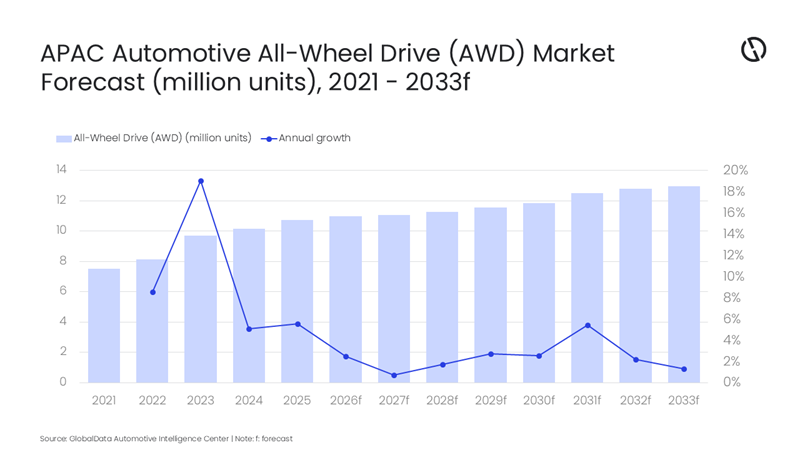
The Asia-Pacific (APAC) all-wheel drive (AWD) system market is evolving from a premium niche into a mainstream buying consideration. Across China, Japan, South Korea, India, and Southeast Asia, automakers are integrating AWD more broadly into SUVs, crossovers, and passenger vehicles to meet expectations for all-weather capability and occasional off-road readiness. Against this backdrop, the APAC automotive all-wheel drive market is projected to grow at a compound annual growth rate (CAGR) of 2.4% between 2026 and 2033, according to GlobalData, a leading intelligence and productivity platform.
GlobalData’s latest report, “Global Sector Overview & Forecast: Automotive Final Drive Systems Q2 2026” reveals that the APAC automotive AWD market is poised to grow from an estimated volume of 11.0 million units in 2026 to 12.9 million units in 2033.

Discover B2B Marketing That Performs
Combine business intelligence and editorial excellence to reach engaged professionals across 36 leading media platforms.
Madhuchhanda Palit, Automotive Analyst at GlobalData, comments: “AWD growth in APAC is being shaped by a clear technology transition: from purely mechanical systems to intelligent, software-influenced drivetrains. Modern AWD solutions increasingly rely on sophisticated control modules and torque distribution strategies that enhance traction and stability in real time—an advantage on APAC’s mix of dense urban roads, high-speed expressways, mountainous terrain, and monsoon-prone regions.”
Electrification adds another layer of opportunity. Electrified AWD (eAWD) in hybrid and battery-electric vehicles, often using dual- or multi-motor configurations, enables more precise torque control and supports broader energy-management strategies.
Policy direction is also one of the key factors shaping the growth of the AWD market. China’s leadership in electric vehicle (EV) production and advanced mobility technologies is accelerating the move toward electrified AWD. In India, policy intent to increase EV penetration through incentives and supportive manufacturing frameworks suggests additional runway for AWD integration in next-generation powertrains, even if adoption will remain price- and infrastructure-dependent across markets.
Palit adds: “Consumer preference shifts are a major tailwind. Passenger cars are the largest and fastest-growing segment for AWD in APAC, driven primarily by the sustained rise of SUVs and crossovers. These body styles align well with regional expectations for higher seating positions, versatility, and added confidence in rain, uneven surfaces, and hilly routes. AWD is also gaining attention in hatchbacks and sedans, particularly among younger and urban buyers seeking improved handling and safety without stepping fully into rugged vehicle categories.”
In APAC, mergers and collaborations are increasingly central to AWD expansion. OEMs and suppliers are partnering to co-develop advanced torque management, intelligent control modules, and software-defined architectures—helping shorten development cycles and strengthen competitiveness.
Palit concludes: “AWD’s growth in APAC is expected to influence vehicle positioning, platform planning, and technology investment across the region’s automotive sector. Traditional AWD should remain the backbone in the near term due to scale and affordability, while intelligent and eAWD steadily expand alongside hybrid and EV penetration. The likely winners in APAC will be those who localize supply, manage cost, and deliver software-led traction and stability benefits that consumers can feel immediately—turning AWD into a practical safety and confidence feature, not just a performance badge.”



