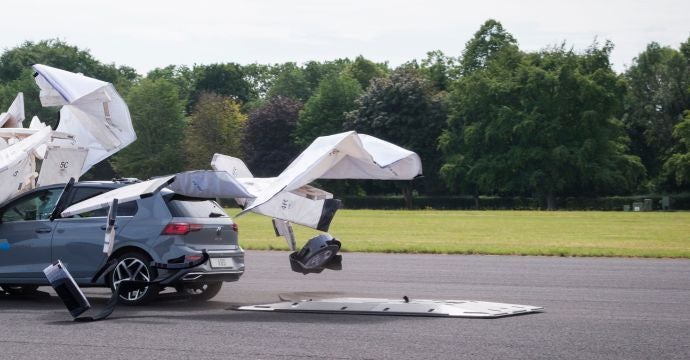
Safety regulator Euro NCAP has updated the 2026 scope of testing regulations with more than 1,200 different test scenarios now existing. The latest protocols have introduced higher speed rear-end collision scenarios up to 130 km/h, with aims to replicate motorway and highway situations.
Discover B2B Marketing That Performs
Combine business intelligence and editorial excellence to reach engaged professionals across 36 leading media platforms.
This new suite of test scenarios sees Euro NCAP being able to distinguish between vehicles offering standard ADAS functionality and those capable of more advanced, higher-performing interventions. Manufacturers equipped to run these new scenarios will be better positioned to achieve higher star ratings.
To assist OEMs with the testing of these high-speed situations, AB Dynamics has launched the GST 120 Plus platform, the fastest and most powerful ADAS testing platform to date. The platform is currently the only one capable of testing speeds of up to 130 km/h, allowing OEMs to test for the latest Euro NCAP rear collision speed requirements. The purpose of the platform is to enable safe, controlled and repeatable car-to-car tests.
The GST 120 Plus is a self-propelled platform designed to carry a full vehicle target for ADAS and autonomous vehicle testing in a safe, controlled and repeatable manner. The platform carries a foam panel car (the DRI Soft Car 360) that can be hit at high-speed without causing damage to the vehicle being tested.
We spoke to Andrew Pick, director, track testing systems, AB Dynamics, to learn more about the new regulations and how automakers are adapting to them.

Just Auto (JA): Could you outline a few of the new Euro NCAP regulations?
Andrew Pick (AP): The Euro NCAP 2026 regulations have been one of the biggest shifts in the protocols yet – that’s illustrated by just the sheer number of test scenarios that there now are in the protocols. The objective around this has been to look at the real-world benefit of ADAS testing and ADAS systems.
Although cars are now regularly achieving five stars on the proving ground, the real-world benefits aren’t necessarily being fully realised; the test protocols have been adapted and modified to try and capture and reward vehicles that really have the most potential to provide real world safety improvements.
There are some new test scenarios with new collision partners. There are new tests that are run from low speeds to look at the possibilities of protecting road users from pedal misapplication type scenarios. There’s also a whole range of new tests at higher speeds, extending the range, and then a robustness layer, which is designed to really check that the ADAS systems work, not just in these specific test cases, but more generally, to give those real-world improvements.
What potential challenges do these regulations present to OEMs?
I think one of the challenges is the sheer volume of testing. With the different combinations and permutations that manufacturers need to carry out, they need to have efficient use of their test tracks.
Another challenge is around running these tests at higher speeds. Some of the very early test equipment was designed for the older regulations. We first started using our GST product in 2018 and at that time the Euro NCAP tests were approved and limited to 80 kilometres per hour, but now the 2026 test protocols specify that the car to car rear braking scenario can be run up to 130 kilometres per hour. That’s been one of the drivers for us to introduce this high-speed platform. We want to enable our customers to be able to run these tests at these high speeds.


How is the new GST 120 Plus platform designed to meet the higher speed requirements?
The new platform has a number of benefits; we’ve really enhanced our current model to release this next generation: GST 120 plus. We’ve had to work across the power train, the brake system and the battery system to enable these high-speed tests.
Part of the project has been to deliver a larger battery. Our battery now has just under six kilowatt hours, which is, we believe, the largest battery of any of these platforms on the market. We have reworked the amplifiers and optimised the gearing so that we can reach these high speeds, but also reach the high speeds in a short distance.
One of the challenges that manufacturers have is that their proving grounds are a certain size. Now the tests are run at high-speed, they need to have more powerful equipment to get to speed quicker otherwise they simply run out of tarmac. The GST 120 helps with that by reaching the high test speeds more quickly.
Do you think that the development of automotive technology is developing at the same rate of regulation updates?
I think the model that Euro NCAP has always used is to look at the state-of-the-art technology and base the protocols around things that are possible, or maybe slightly stretch the capabilities of existing technology.
What that means is, if you are a leading vehicle manufacturer with the highest performing technology, you’ve got a really good position to be awarded and rewarded for that innovation. It creates a carrot to encourage other vehicle manufacturers to develop their capabilities, to catch up and keep up and achieve the same level.
That’s the lever that Euro NCAP uses to push safety development forwards. I think specifically in these new protocols, there are some new test requirements. One example is crossing scenarios.
They’ve introduced a series of test scenarios that are looking at protecting motorcyclists at crossroads. There’s a motorcyclist approaching from the left and the car is bearing down at an intersection at right angles, and that motorcyclist could be in the blind spot of the vehicle. It’s also the blind spot caused by the A-pillar of the vehicle, but as it’s approaching it’s to the side of the vehicle, which means that the traditional sensors that vehicle manufacturers have relied on, these forward-facing sensors, won’t necessarily detect an object approaching from the side. So vehicle manufacturers have had to enhance their capabilities of their sensor stacks so that they can start detecting these potential collisions that might come now from the side, or during a turning scenario when they’re turning across the path of oncoming vehicles.
How are manufacturers preparing for these challenges?
I think the Euro NCAP protocols have created quite a milestone of technology developments, and what you’ll probably see, if you look back at the Euro NCAP web pages, you can see all the vehicles they’ve tested, and there’s a big rush to test vehicles just when the protocols change.
Many vehicles have been testing to the standard protocols that were in force in 2025 so that they can have their five stars and have the longevity before they need to retest. It’s now that in 2026 that the new protocols have arrived, there’s a big step change in the performance that manufacturers need to deliver.
Some of them have got ahead, and perhaps got the testing in early. Others will be testing to the new standards, but Euro NCAP do have an allowance that means that you can still achieve five stars, but with slightly lower scores across the board.
I think that’s the interesting thing, because Euro NCAP have moved to a three-year cycle on this milestone, and that, to some extent, drives vehicle manufacturers testing regimes. The tests that they’ve now introduced for 2026 need to have the longevity right through till 2029 and I guess that there will be some minor changes. One of the levers that Euro NCAP can apply, is not necessarily to change the protocols, but they can change the weight ratings and the scorings. Perhaps we’ll see the extended tests and the robustness tests having more weight in the overall ratings, but of course, they’re more difficult to pass.
What do you see short-term and long-term holding for vehicle testing?
With this new release, Euro NCAP has split the ratings into four key pillars. One of them is about safe driving, and that means the hours before a potential accident. They’re rating assisted driving, adaptive cruise control, as part of those ratings. Some of those ratings and some of the tests around the assisted driving protocols also require the soft target dummies and things that we manufacture.
The crash avoidance is the main pillar where there’s been a huge growth in the number of tests. There are 1,200 test scenarios across that crash avoidance protocol alone. Then you’ve got crash protection, which is, if you have a crash, the passive safety elements.
Then the final pillar is post-accident. They’re talking about accident extraction of passengers to enable information that enables emergency services to access the vehicle occupants more easily.
The line between safe driving and crash avoidance begins to merge when you have assisted driving capabilities that automatically slow the cars down, or perhaps have a function to automatically steer the vehicle. I think that’s an area that Euro NCAP will potentially explore in the future.
I think this theme around real-world performance will push Euro NCAP to take note of some of the on road testing that’s now part of the protocols.
How do you work with proving grounds?
Across the company, the stakeholders for the development of this technology sit with the sensor suppliers, Tier-One suppliers, vehicle manufacturers, and then the proving grounds.
Across Europe there are 10 proving grounds that deliver official Euro NCAP tests. Where proving grounds are running these tests, they’re running strictly to the protocols, and they will be running tests for vehicle manufacturers. They’ll be running pre-tests for vehicle manufacturers, and they may also be running the official tests. They need to have all the capabilities that vehicle makers have to run and rate these ADAS features.
I think the some of the challenges are around the fact that they’re set so many tests. At some point someone might want to test all the permutations and combinations, but those official proving ground tests that are run by the NCAP labs are limited to spot checks around a wider matrix of the individual tests.
Lots of proving grounds are now investing in new surfaces specifically for ADAS, and they’re different to the vehicle dynamics platforms that tend to be narrow roads with lane markings, or crossings and crossing roads where you’ve got long approaches in two directions to run these kind of high speed crossing scenarios.
What is the process for running the tests?
Actually delivering those tests it’s not just about running the test on the proving ground. We really see three phases to delivering and executing a successful test. The first phase is planning the test, part of what we’ve been doing around this new platform delivery is to introduce new software. We’ve got some special groups that introduce and have all of the 1,200 tests pre-configured, so that takes away the burden, and the time that it would take to run all those and plan all those tests individually. They’re pre-configured, so you can pick the ones you want to run,
Then when you come to execute the test, proving grounds have got limited space, so we’ve worked really hard to optimise the paths and the speed profiles so that our platforms and the robot vehicles accelerate and reach test speed in the most efficient and optimal way.
We’ve pre-configured the changing speed profile into the commanded path so that we get the best response during those tests.
When you’ve run the test, you want to be sure you’ve got the right data and that everything is in tolerance and in spec. We’ve built it post processing so that outside of the track you can look at your data and see straight away whether it meets the required metrics, and you ran the test in a valid way to tolerance. It’ll also give you the KPIs defining the performance of the ADAS system.