Britain’s transition to zero emission vehicles must urgently be reviewed before targets accelerate exponentially from 2027, the UK’s automotive industry has warned. In a strongly worded statement, the SMMT said the country’s net zero and economic growth ambitions could be thwarted under current arrangements.
New analysis published today by the Society of Motor Manufacturers and Traders (SMMT) shows the UK’s transition pathway was built on assumptions that have proved to be over-optimistic. Despite changes to regulatory flexibilities and the return of consumer incentives, the gap between policy ambition and market reality continues to widen, the SMMT said.
Go deeper with GlobalData


Discover B2B Marketing That Performs
Combine business intelligence and editorial excellence to reach engaged professionals across 36 leading media platforms.
The UK’s auto industry trade association said that conditions have changed so much that failing to reassess the route risks undermining the very objectives the policy was designed to achieve.
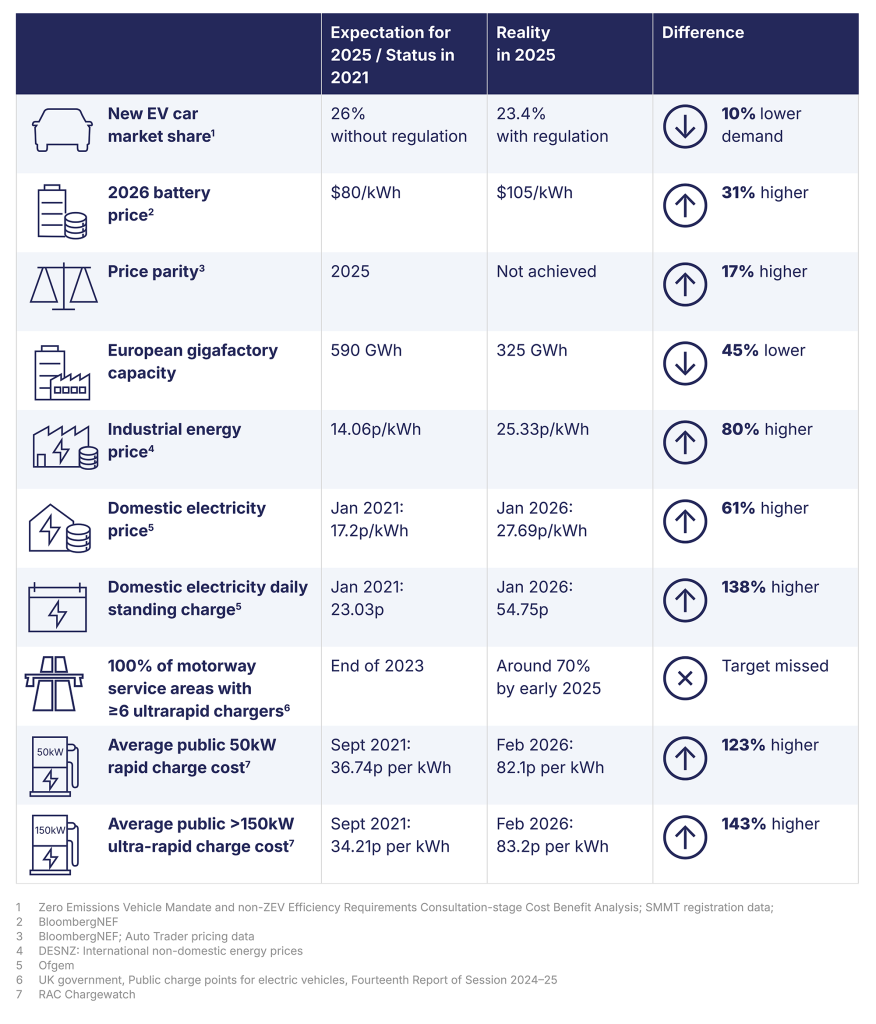
Despite having the highest battery electric vehicle (BEV) market share of any major European market, the UK is already falling short of its own expectations. In 2025, battery electric vehicles accounted for 23.4% of new car registrations – below the 28% ZEV mandate requirement, and short even of the 26% government originally expected would be achieved without regulation. This is despite UK drivers enjoying a massive choice of more than 160 BEV models – the result of billions of pounds invested by manufacturers.
The SMMT maintains that the industry has thus far bridged the gap between ambition and demand through unprecedented levels of discounting – more than £10 billion over the past two years – and by using mandate flexibilities. However, such subsidies are unsustainable and undeliverable when at the end of 2027 the targets become significantly tougher (52% for cars, 46% for vans).
The SMMT says that natural market demand will not deliver the doubling in new car market share in two years, never mind the quadrupling of electric van market share, needed to achieve these targets. Without action to close the gap, fleet renewal and parc decarbonisation will slow, and the UK’s attractiveness as both a vehicle market and manufacturing base will be put at risk.
Global events have undermined the assumptions underpinning the energy transition in transport, according to the SMMT. Analysis in Same Destination, Smarter Route, a new report published at SMMT’s Electrified conference, shows how battery costs are more than 30% higher than anticipated, raw material costs remain stubbornly high, and UK and EU industrial energy prices have risen 80% and 28% respectively since 2021. As a result, the expected price parity between electric and conventionally fuelled vehicles has not materialised, restricting the pace of transition. Charging infrastructure has increased but the cost of public charging has, in some instances, gone up by more than 140% in the past five years, while a target of at least six ultra-rapid chargepoints at every UK motorway service area by the end of 2023 was only around 70% complete in early 2025.
The challenges are even greater for commercial vehicles. While almost two thirds of new van models are now available as zero emission, uptake in 2025 was 9.6%, barely half of the 16% required by regulation. For heavy goods vehicles, adoption is only just beginning – just 1.4% of the market in 2025 – reflecting the sector’s diverse operating requirements, high upfront costs and the scale of charging and refuelling infrastructure still needed.
Above all, the SMMT points out that the geopolitical landscape has fundamentally changed with knock-on effects on energy markets, business and consumer confidence, and attitudes to trade which are increasingly protectionist. Only last week, the EU published its draft Industrial Accelerator Act which threatens trade in the very vehicles the EU and UK seek to promote.
Against this backdrop, the industry is calling on government to undertake an urgent strategic review of the transition to zero emission vehicles. This must consider all relevant factors, including the regulation, to assess whether the pathway remains realistic and is aligned with economic growth, recognising that market strength matters to the UK investment proposition.
Other major markets such as the EU and Canada have already altered their transition plans, and the US has rowed back on its EV commitments altogether.
Mike Hawes, SMMT Chief Executive, said: “The UK’s EV transition pathway was conceived with the best of intentions – but the assumptions behind it have proved over-ambitious. A landscape which once looked solid has turned out to be quicksand. Recognising the world of 2026 is not the one envisaged five years ago is not a retreat from ambition; it is a necessary step to achieving it. We need an urgent review that reflects today’s realities, that delivers decarbonisation not deindustrialisation and offers consumers the choice they have always expected.”