
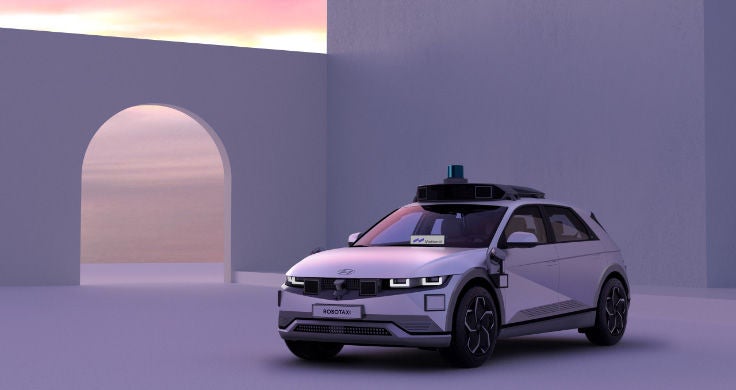
Hyundai Motor Group (HMG), comprising Hyundai Motor and Kia Corporation, has agreed to collaborate with the Korea Advanced Institute of Science and Technology (KAIST) to develop new autonomous driving sensors, according to local reports.
Despite the automotive industry’s delays in commercialising autonomous driving systems, the automaker has linked up with one of the country’s main research oriented universities to establish a new research laboratory to develop new on chip light detection and ranging (LiDAR) systems.
Go deeper with GlobalData


Discover B2B Marketing That Performs
Combine business intelligence and editorial excellence to reach engaged professionals across 36 leading media platforms.
The new centre will employ 30 engineers from Hyundai, Kia and KAIST’s School of Electrical Engineering to develop a small, high performance, on chip sensor capable of various functions including signal detection based on semiconductor technology.
The automaker said new signal detection technology uses frequency modulated continuous wave (FMCW) emitting light which changes its frequency over time and reads the returning light frequency to measure distances.
HMG said this collaboration was expected to result in technology which would enable mass production of low cost LiDAR systems.
“This collaboration is expected to advance the era of fully autonomous driving.”




